Air quality · Practical guide
For smoke and fine particles, “has a HEPA filter” is not enough information. The appliance also needs to move enough clean air for the room. That makes particle/smoke CADR a more useful comparison point than a marketing room-size claim by itself.
The U.S. EPA says portable air cleaners can reduce particles in a room, but they do not remove every pollutant and they do not replace source control. When outdoor smoke is heavy, ventilation should wait until the outdoor air becomes cleaner again.
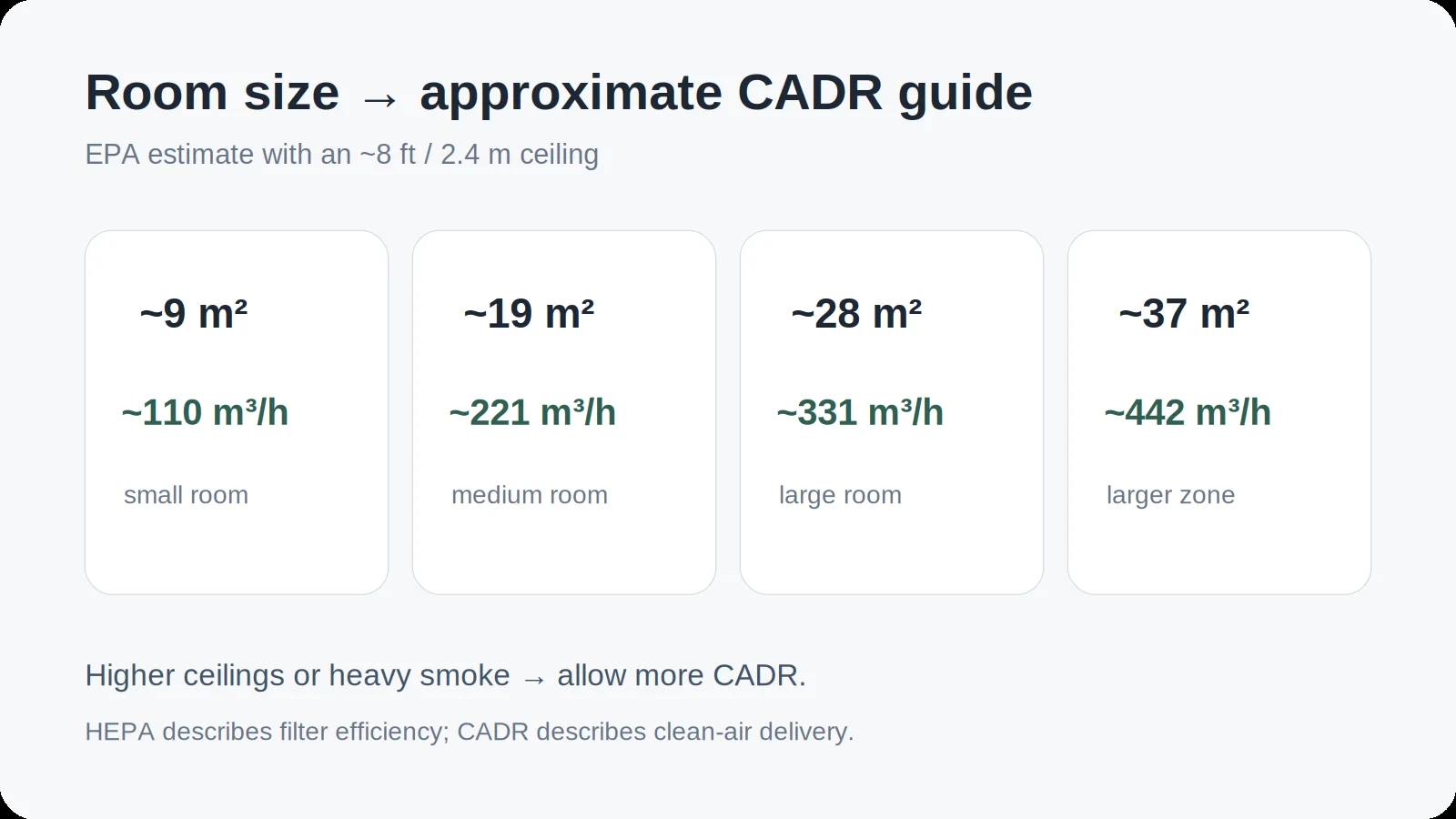
How to size the purifierEPA's current consumer guide gives an estimated minimum CADR of 65 cfm for 100 ft², 130 cfm for 200 ft², 195 cfm for 300 ft² and 260 cfm for 400 ft² with an 8-foot ceiling. That is about 110, 221, 331 and 442 m³/h for rooms of roughly 9.3, 18.6, 27.9 and 37.2 m². If your ceiling is higher, choose a unit with more CADR.Room areaApprox. minimumPractical note~9 m²~110 m³/hSmall bedroom or office~19 m²~221 m³/hMedium room~28 m²~331 m³/hLarger living room~37 m²~442 m³/hAdd reserve for a high ceilingHEPA describes filter efficiency: by definition it can theoretically remove at least 99.97% of airborne particles at 0.3 μm under the test criterion. Real room cleaning also depends on airflow, sealing and run time.
How to use it during a smoke episodePlace the purifier in the room where you spend the most time and keep its intake and outlet clear. Higher fan speeds and longer run times filter more air. Watch filter loading and replace filters according to actual use and manufacturer guidance.If outdoor air is smoky and unhealthy, limit the amount of polluted outdoor air entering the room. When outdoor air improves, air the home out. During longer smoke events, a dedicated cleaner-air room with an appropriately sized purifier can reduce exposure.
What not to expectA particle filter is not automatically a gas or odor solution. Gas removal needs an appropriate sorbent, such as a meaningful amount of activated carbon, while CADR is primarily a particle-performance rating. Avoid devices that intentionally generate ozone in occupied spaces.Bottom line: for smoke and PM2.5, look for HEPA or verified fine-particle filtration, but size the appliance by CADR for the real room. If two units use comparable filters, the one that can deliver enough clean air at a noise level you will actually tolerate is usually the more useful choice.
SourcesU.S. EPA — Guide to Air Cleaners in the Home, updated Feb 17, 2026U.S. EPA — What is a HEPA filter?, updated Jan 13, 2026U.S. EPA — Reduce Your Smoke Exposure


