Heating · Comparison
Both use electricity, but they do different jobs. For sustained heating, a properly selected air-to-air heat pump usually has a strong electricity-use advantage; a convector can still make sense for an occasional room, backup heat or a difficult installation.
The useful question is not “which one is better?” but which one fits the way you will actually heat the room.
The key difference: one makes heat, the other moves it An electric convector uses a resistance element to produce heat and release it into the room. A heat pump also uses electricity, but mainly to run its compressor and fans while transferring available heat from outdoor air into the building. That is why an air-source heat pump can deliver more heat to the room than the electrical energy it consumes directly. This is the technical reason for its advantage during long operating periods — not a promise of a fixed percentage saving for every home. A heat pump has the strongest case for regular heating and when cooling is also useful; a convector can be practical for an occasional small room, backup heat or a difficult installation.
Side-by-side comparisonUnderlying trade-offs — not a substitute for a heating-load calculation or comparison of specific models.CriterionAir conditioner / air-to-air heat pumpElectric convector Electricity use for sustained heatingUsually lower when correctly sized and operating in suitable conditionsHigher for the same useful heat because heat is produced directly from electricity Upfront costHigher; indoor and outdoor units plus installationUsually simpler to buy and put into use Cold-weather operationCapacity and efficiency change with outdoor temperature and modelDoes not depend on extracting outdoor heat; available electrical power remains the main limit Comfort and noiseMoves warm air; uses fans and a compressorSimpler and often quiet as a local heat source MaintenanceFilters, heat exchangers and periodic professional servicingSimpler system with less maintenance Summer coolingYes, with a reversible unitNo Small room used rarelyMay be an unnecessarily complex investmentOften practical
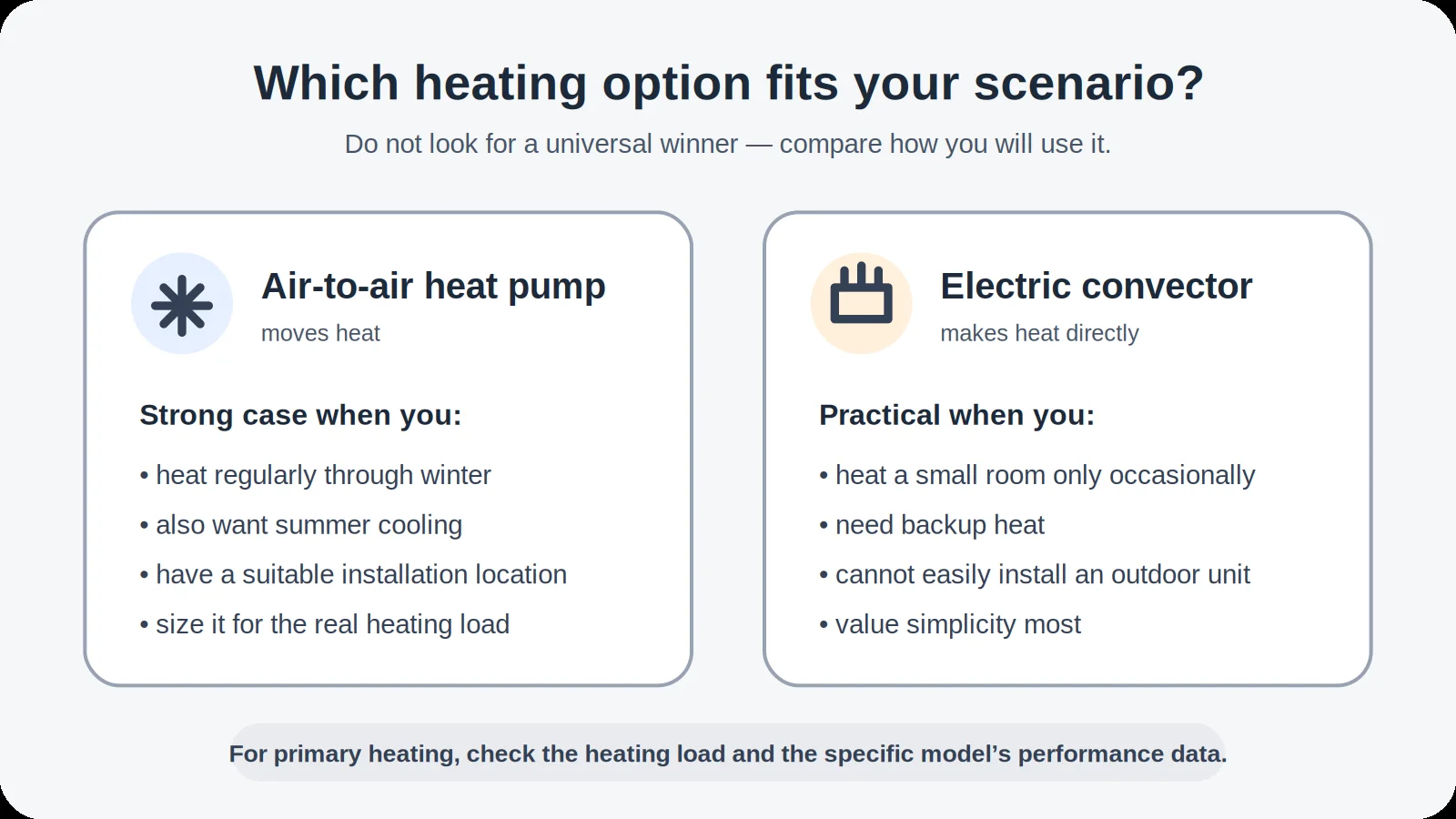
When the heat pump has the strongest case You heat the space every day through most of winterThe more hours the system runs, the more important electricity consumption becomes. In a regularly heated living space, a heat pump has many more operating hours in which its efficiency advantage can matter. You also need cooling in summerA reversible air conditioner solves both seasonal needs. If cooling is already part of the requirement, the investment should not be judged only as the purchase price of a winter heater. You can choose a model for the actual winter heating loadNominal capacity on a marketing chart is not enough. If this will be the main heating system, look at the specific model’s heating capacity at low outdoor temperatures and how its efficiency changes as conditions become harder.
When an electric convector is still a sensible choice The room is used only occasionallyA guest room, small workshop or space heated for short periods may not justify the higher initial investment of a heat pump. When annual operating hours are low, simplicity can matter more than seasonal efficiency. You want backup heatA convector can be a convenient secondary source for one room. That is a different use case from heating the whole home throughout winter. Installing an outdoor unit is difficultFaçade restrictions, access, floor level, building rules or a poor location for an outdoor unit can make a heat pump awkward or expensive in a particular property.
What happens when it gets very cold outside?There is no single outdoor temperature at which every heat pump suddenly stops working. Different models have different operating limits, capacities and efficiencies. As temperature falls, conditions become more demanding, so a main-heating decision should use the manufacturer’s low-temperature capacity data for the specific unit.
Insulation can change both scenariosEven the most efficient heater cannot eliminate a building’s heat loss. If substantial heat escapes through windows, doors, roof or walls, the energy required to maintain indoor temperature remains high. Part of the budget can sometimes produce more value when obvious draughts and envelope weaknesses are addressed first.
Do not compare only the purchase priceA useful money comparison needs at least the approximate heating load, operating hours and indoor temperature, the specific heat pump’s performance under your conditions, the current electricity tariff and a real purchase-and-installation quote. Without those inputs, a claim such as “it pays for itself in two years” is a guess.
Quick decision by scenarioLean toward an air conditioner / heat pump if you heat regularly, want cooling as well, have a suitable installation location and can select the unit against the real winter heating requirement.Consider an electric convector if you heat a small room only occasionally, need backup heat, or installation simplicity and lower upfront commitment matter more than electricity use during long operating hours.If this is the main heating system for the entire home, do not choose solely from a square-metre marketing chart. Heating load, building heat loss and the selected model’s low-temperature performance matter more than the generic labels “air conditioner” or “convector.”
SourcesChecked 9 September 2026.European Commission — Heat pumpsEuropean Commission — Zero-emission buildingsU.S. Department of Energy — Heat Pump SystemsU.S. DOE FEMP — Residential Air-Source Heat Pumps
Pilot publication · noindex,nofollow · Updated 9 September 2026.


