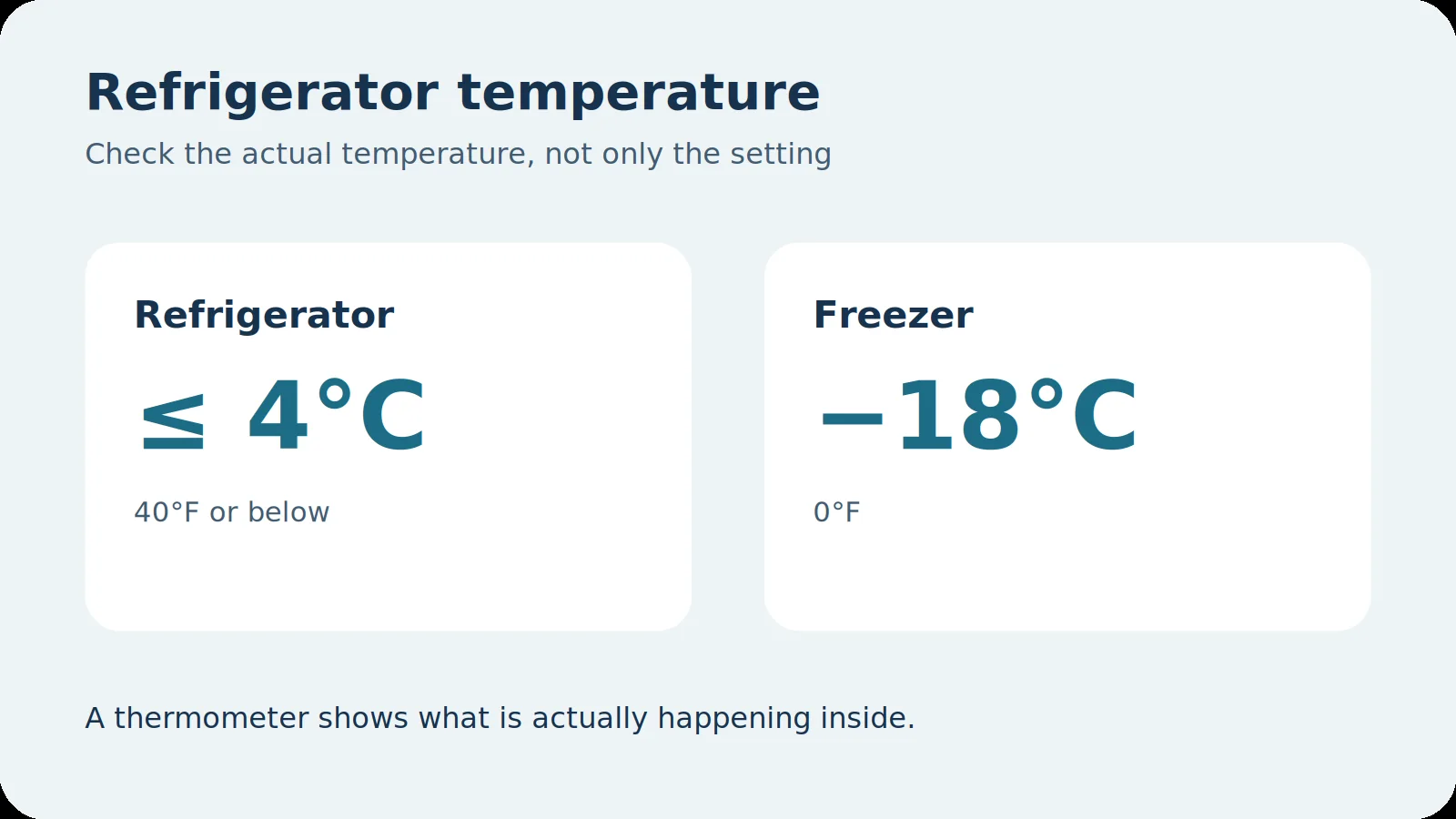
The practical answer is 4°C (40°F) or below. That is the upper safe limit recommended by the FDA for household refrigeration. Do not rely only on a dial or display: verify the actual cabinet temperature with an appliance thermometer.
Why 4°C matters
The FDA recommends keeping refrigerators at 40°F (4°C) or below and freezers at 0°F (-18°C). Chilling does not sterilise food, but it slows the growth of dangerous microorganisms. Temperature is therefore a food-safety control, not merely a comfort or energy setting.
A useful practical setting: if your appliance allows precise control, aim for roughly 3–4°C and verify with a separate thermometer that the storage zones stay below 4°C.
Do not trust the display blindly
A digital setpoint or a 1–5 thermostat position may not equal the temperature around your food. The FDA recommends an appliance thermometer because it shows the actual cabinet temperature. Put it in the main compartment and check it at different times, particularly after loading groceries.
How to check your fridge
- Place a refrigerator thermometer in the middle area rather than on the door.
- Allow the temperature to stabilise and read it more than once.
- If it repeatedly rises above 4°C, lower the setting and check again.
- Do not pack shelves so tightly that cold air cannot circulate.
- After a large grocery load, allow the appliance time to recover.
Where to keep sensitive foods
The door usually experiences the largest temperature swings because warm room air enters every time it opens. Milk, meat, fish, eggs and ready-to-eat food are better kept in a more stable internal zone according to your refrigerator's design. Raw meat should be sealed and positioned so that drips cannot contaminate ready-to-eat food.
What if the power goes out?
The FDA says an unopened refrigerator will generally keep food cold for about four hours during a power outage. Keep the door shut. When power returns, judge perishable food using measured temperature and elapsed time rather than smell or appearance alone.
Common mistakes
- “Colder is always better”: an excessively low setting can freeze some foods and waste energy.
- “If it smells fine, it is safe”: dangerous bacteria do not always change smell, taste or appearance.
- “The display says 4°C, so every shelf is 4°C”: temperatures vary across the cabinet, which is why a thermometer check is useful.
Bottom line: adjust the refrigerator so the real temperature stays at 4°C or below. Verify it with a thermometer, leave room for airflow and keep sensitive foods in the more stable internal zones.


