Temperature · safety · energy
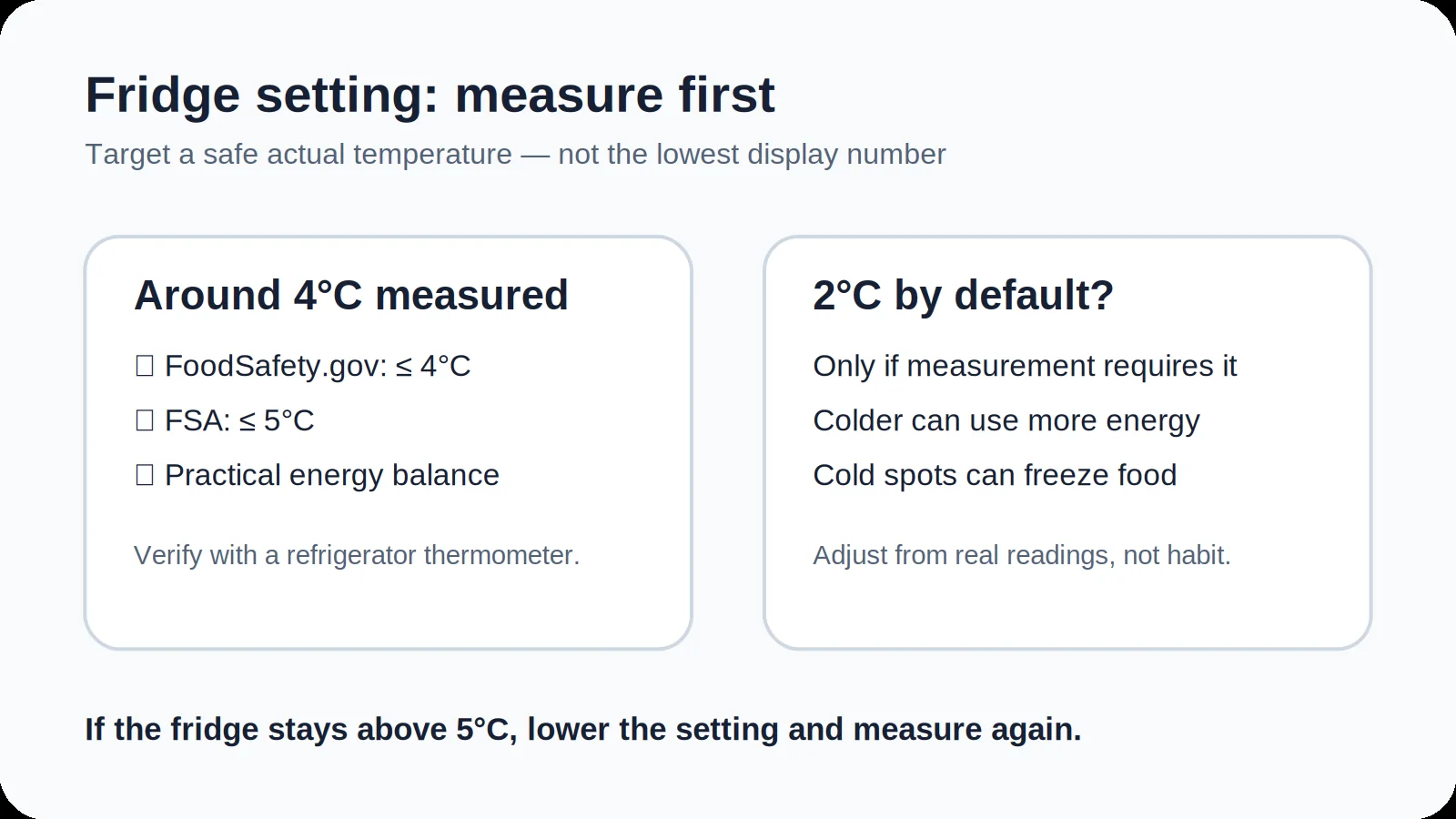
For most homes, an actual temperature around 4°C is a better starting point than automatically setting the refrigerator to 2°C. FoodSafety.gov recommends 4°C or below, while the UK Food Standards Agency recommends 5°C or below. The U.S. Department of Energy recommends 36–40°F (about 2.2–4.4°C) and notes that colder settings unnecessarily increase energy use without adding food-storage benefit.
Quick decision
SituationWhat to doWhyFridge actually holds about 4°CLeave it aloneIt is within the safe range; there is no reason to cool harder just to show a lower number.You measure above 5°CLower the setting and recheckFSA recommends 5°C or below.Food freezes on shelvesRaise the set temperature slightly and move food away from cold spotsA 2°C display can coexist with even colder local zones near an outlet or rear wall.You do not know the actual temperatureUse a refrigerator thermometerFSA notes that fridge dials do not always show the correct temperature.
Why 4°C is a useful target
FoodSafety.gov uses 4°C or below for refrigerated food storage. FSA allows a slightly wider 5°C or below target and recommends checking with a thermometer. These are practical control targets, not a claim that food becomes instantly unsafe a fraction of a degree above 4°C.
Why 2°C is not automatically better
A colder set point creates extra margin during frequent door opening or uneven cooling, but it has costs. DOE recommends 36–40°F and says temperatures below that range unnecessarily increase energy consumption. Very cold areas can also freeze some foods, particularly near the back wall or cold-air outlets.
Practical rule: do not chase the lowest setting. Adjust the fridge so its measured temperature stays reliably around 4°C during normal use and does not remain above 5°C.
Measure instead of guessing from the dial
On mechanical “1–5” controls the number often represents cooling intensity rather than degrees. Even a digital set point does not capture local variation caused by loading, door opening and compressor cycles. Use a fridge thermometer and judge a stable pattern rather than one instant reading.
Do not overfill the cabinet: FSA recommends leaving space for air circulation. If the fridge runs too warm, also check the door seal, blocked vents and recent loading with warm food before simply selecting the coldest setting.
What about the freezer?
The reference point is clearer: FoodSafety.gov recommends -18°C (0°F) or below. DOE similarly places normal home-freezer operation around 0°F and warns that unnecessarily colder operation uses more energy.
Decide in five minutes
- Do not change the setting by feel alone.
- Check the actual compartment temperature with a thermometer.
- If it is around 4°C and food is not freezing, keep the setting.
- If it remains above 5°C, lower it one step and measure again.
- If food freezes, raise the temperature slightly or move items away from the coldest zone.
SourcesFood Standards Agency — 5°C or below and thermometer guidanceFoodSafety.gov — 4°C or below for refrigerators and -18°C for freezersU.S. Department of Energy — 36–40°F and energy trade-offChecked on 10 September 2026. Also follow the instructions for your specific appliance model.


