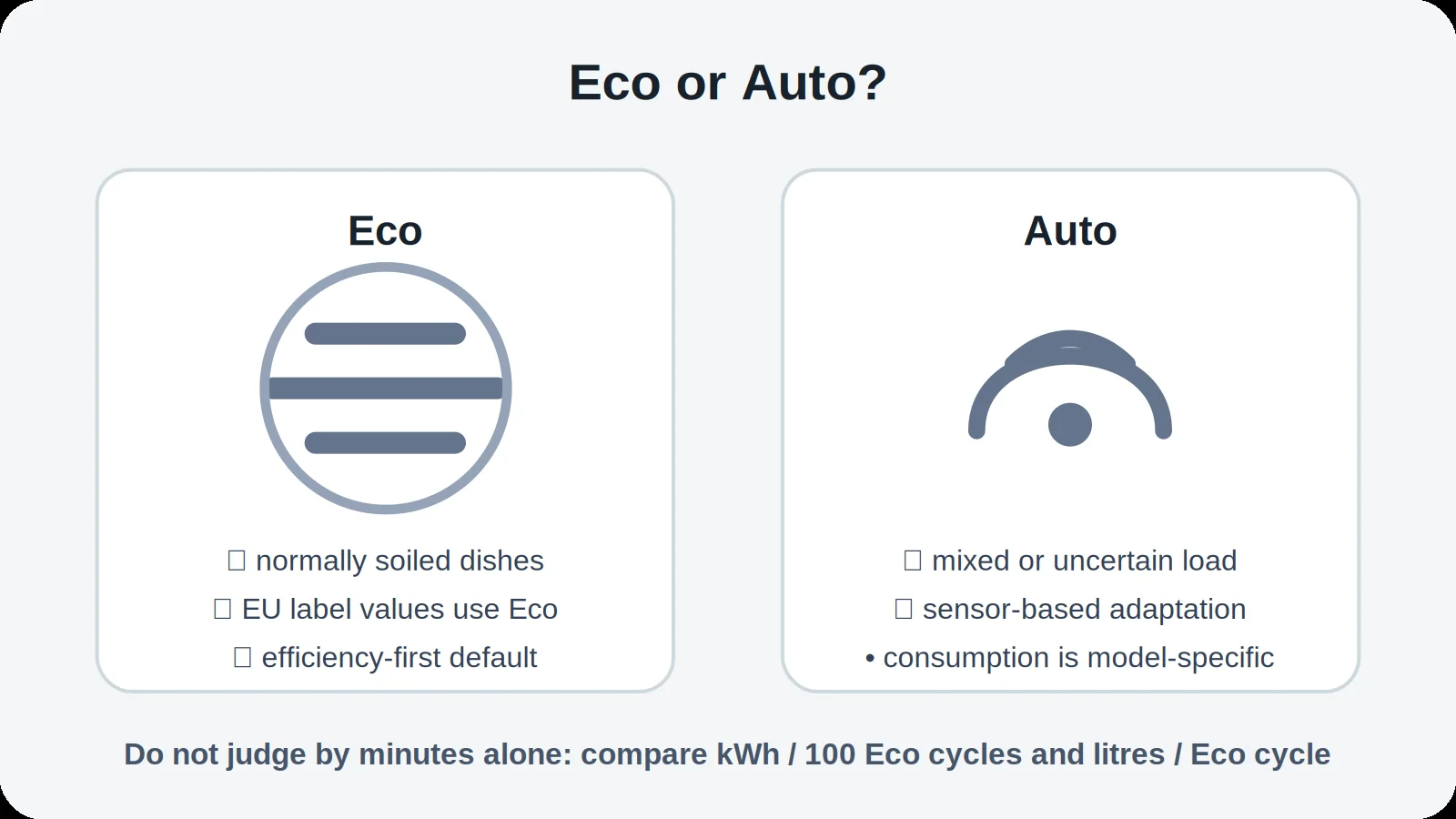
For a typical, normally soiled and reasonably full load, start with Eco. In the EU, this is the programme used for the energy-label measurements for energy, water, capacity and duration. Auto is more useful when the load is mixed, the soil level is uncertain or you want the machine to adapt the cycle using whatever sensors that specific model provides.
The short answer
SituationEcoAutoNormally soiled dishesFirst choiceAlso suitableGoal: comparable efficiency dataYes — EU label values are based on EcoNot standardised across brandsMixed/uncertain soil levelFine when within the programme's intended loadOften more convenientTimeOften longerMay adapt to the loadHeavily burnt-on cookwareNot the first choiceDepends on the model; Intensive may be better
Why can Eco take so long?
A long cycle does not automatically mean high energy use. In a dishwasher, a large part of the energy goes into heating water. Eco is designed to meet cleaning and drying requirements while controlling energy and water use, even if that means taking more time. The European Commission explicitly states that efficiency and functional requirements apply to the Eco programme.
Do not judge efficiency by minutes alone. On the EU label, look at kWh per 100 Eco cycles and litres of water per Eco cycle. Duration is shown too, but by itself it does not tell you how economical the machine is.
What does Auto actually mean?
“Auto” is not one standardised programme shared by every manufacturer. It is model-specific logic. On some machines, sensors assess the degree of soiling and adjust cycle parameters. In an official Bosch dishwasher manual, for example, Auto programmes are described as being optimised according to soiling with the help of sensors.
That makes Auto a sensible choice when you are unsure whether the current load is lightly or more heavily soiled and prefer convenience over a fully predictable reference cycle. But do not assume that “Auto” on two different dishwashers uses the same temperature, water or time.
Does Eco always use less than Auto?
There is no honest universal “yes” for every model and every load. What is certain is that Eco is the regulated European reference programme and its values are the ones shown on the energy label. Auto is an adaptive manufacturer-defined feature.
For normally soiled dishes when you are not in a hurry, Eco is the best starting point. If the machine is only partly full, the load is unusually mixed or the soil level is hard to judge, Auto can be more practical — especially on a model with well-designed sensor logic.
Three mistakes that matter more than Eco vs Auto
- Running a nearly empty dishwasher. Unless there is a special reason, a properly loaded machine makes better use of its capacity.
- Pre-washing everything under hot running water. Remove large food scraps, but do not turn preparation into a second wash.
- Using Intensive by habit. A heavy-duty cycle is useful for burnt-on cookware, but there is little reason for it to be the daily default for ordinary soil.
A 20-second decision rule
- Normal daily load, no hurry → Eco.
- Mixed load and uncertain soil level → Auto.
- Burnt-on pots and pans → Intensive or the programme recommended by the manufacturer.
- You need dishes quickly → Quick/Express, accepting that speed is not necessarily the most efficient operating mode.
How to compare two dishwashers in a shop
Since 1 March 2021, the EU label uses an A–G scale. It shows the energy class, kWh per 100 Eco cycles, litres of water per Eco cycle, capacity, programme duration and noise. The QR code links to EPREL, where you can verify the specific model's parameters.
That is a stronger basis for a purchase decision than a marketing claim such as “intelligent Auto programme”. Auto can be a useful feature; the label gives you comparable data.
Bottom line
Eco is the right default for most normal everyday loads. Auto is valuable when you want the dishwasher to adapt to a less predictable load. Do not choose only by the time shown on the display: with dishwashers, the longer cycle may be the more efficient one, and that is why the official EU label measures consumption on Eco.


